
As the wave of intelligentization sweeps across the automotive industry, more and more car manufacturers are choosing to showcase their technological ambitions and innovative achievements under the spotlight of CES. This has even led to CES being playfully referred to as the “second-largest auto show in the United States.”
Reporters noticed that technology companies such as NVIDIA, LG Electronics, and Bosch have all showcased platforms like automotive large models and AI cockpits at CES. Among them, NVIDIA launched the thinking and reasoning model Alpamayo, which will be first used in the 2025 Mercedes-Benz CLA. BMW announced its entry into the new generation of automotive platforms, focusing on intelligent personal assistants and the upgraded sixth-generation eDrive technology.
The Geely Galaxy M9, equipped with the end-to-end large voice model Step-Audio2, made its debut at CES. The English AI assistant in the cockpit is the industry’s first interactive system equipped with an end-to-end large voice model, attracting on-site audiences to line up for hands-on experiences.
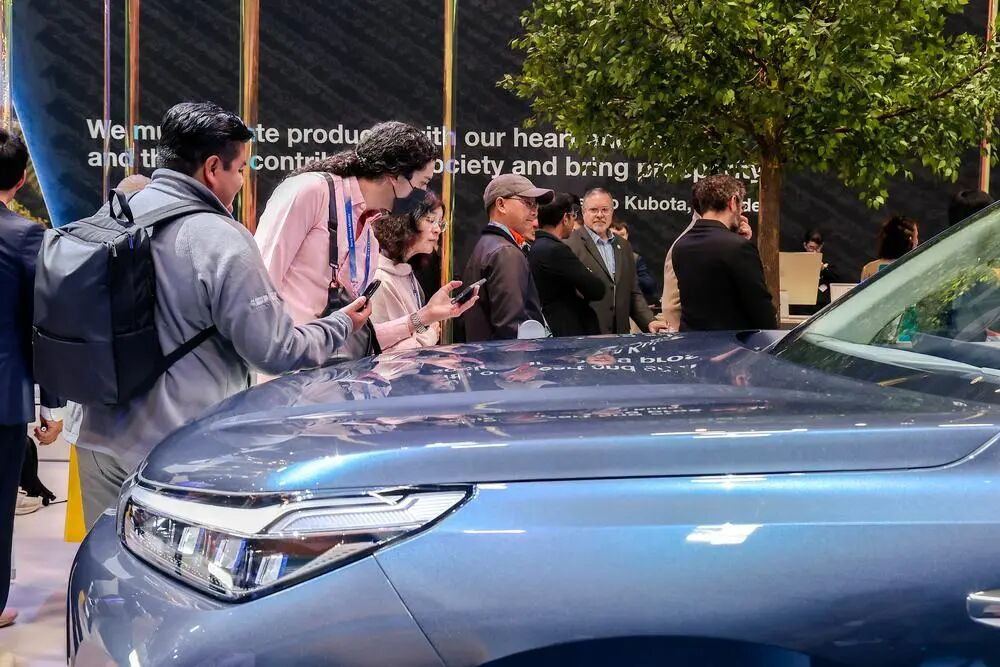
At the Geely booth, audiences line up to experience the Geely Galaxy M9
Li Jing, the vice president of Step-Audio, told a reporter from Science and Technology Innovation Daily that if 2025 is considered the first year of large models being integrated into vehicles, then in 2026, we can expect to see more intelligent cockpit overall solutions being implemented. There may even be large-scale mass production and application of entry-level Agents in automotive cockpits.
The integration of end-to-end large voice models into vehicles signals an approaching inflection point for intelligent cockpits
Li Xiang, the founder of Li Auto, once publicly stated that “AI represents the entire future of Li Auto.” Today, competition in the automotive market has fully shifted towards intelligentization. In 2026, automotive technology will focus on the intelligent reconstruction of the “third space.” Cars are no longer just means of transportation but extensions of mobile offices, entertainment centers, and smart homes.
Intelligent cockpits equipped with large models are regarded as the next-generation product form. Leading car manufacturers and base model providers are the two core driving forces. Large model companies such as ByteDance and Step-Audio are actively exploring this area.
Among them, ByteDance’s Doubao large model has established partnerships with many automotive brands, including Mercedes-Benz, SAIC Audi, SAIC Roewe, Changan Mazda, and Dongfeng Yipai.
The Geely Galaxy M9, a collaborative model between Step-Audio and Geely showcased at CES, has taken the lead in mass production and has sold 40,000 units in the four months since its launch.
Li Jing, the vice president of Step-Audio, said that as intelligent driving becomes more mature, intelligent cockpits will become increasingly important. According to him, Step-Audio’s end-to-end large voice model offers a different experience from previous in-vehicle voice systems. It can understand human emotions, has emotional intelligence and memory, can change voices at any time, and can act like a native guide, chatting about topics from South Korea to Las Vegas.
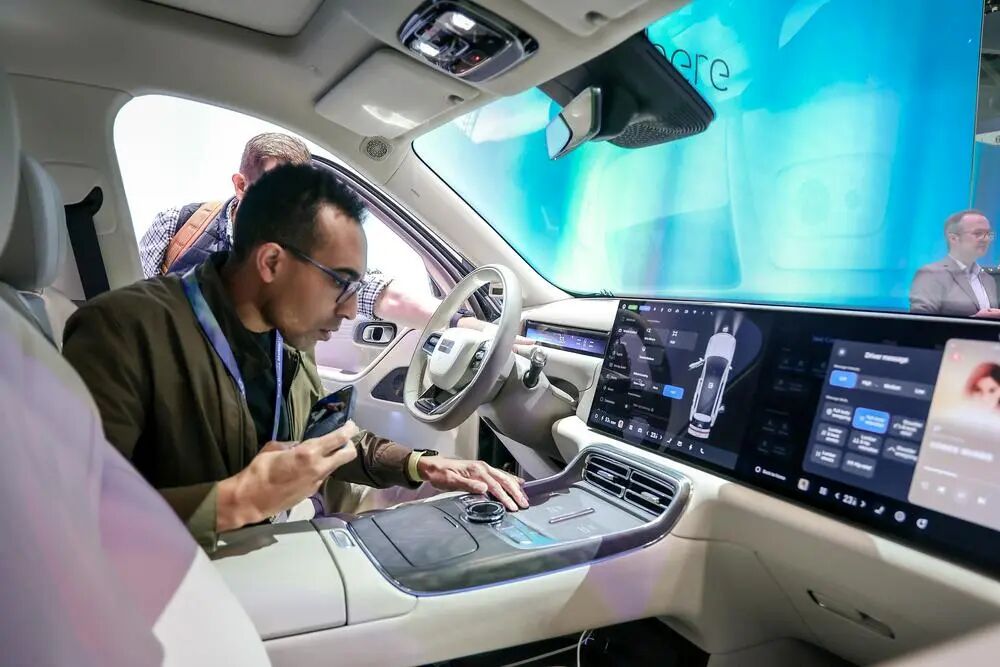
Foreign audiences at CES experience the intelligent cockpit interaction of the Geely Galaxy M9
“Since 2025, large models have been influencing the in-vehicle experience at a very fast pace. Intelligent assistants can now receive instructions in a more open-ended manner, have memory capabilities, support multiple languages, and even provide emotional value by responding to users’ emotional states. They have transformed from the rigid voice assistants of the past into in-vehicle companions. As the third living space, the potential of the current cockpit has far from been fully explored. It is a natural terminal carrier suitable for hosting super assistant Agent products.“
Systematic AI capabilities will be presented in 2026
2025 is considered the first year of large models being integrated into vehicles. After a year of rapid iteration, car manufacturers’ application of large models has gradually shifted from the initial hasty trials to a stage of in-depth exploration and integration.
In 2026, the role of cars has become clearer. Intelligent cockpits assume the combined functions of entertainment, work, and social interaction, and natural language interaction is replacing traditional human-machine interfaces.
“In 2025, there was more of a display of atomic capabilities. In 2026, it is expected that more overall solutions for intelligent cockpits, such as entry-level Agents, will emerge. It is very likely that they will appear this year. From personalized memory and active execution to content service experiences and Agents that understand you, this entire set of solutions will be used in specific mass-produced models in cockpits. The implementation progress may be faster than that of other terminals such as mobile phones,” Li Jing told the reporter.
Du Fang, the product director of Pateo, also believes that AI will become a native capability of the operating system (OS).
“Currently, most AI functions in cockpits rely on cloud computing power for support. However, AI with end-cloud collaboration is the core development direction for the future. Deeply integrating AI capabilities into the underlying layer of the OS is not only the core foundation for vehicle intelligence but also the computing core for achieving the integration of multi-domain experiences in cockpits, intelligent driving, and chassis. Specifically, it needs to extend down to the underlying architecture of the OS and expand up to the cloud Agent ecosystem level. This includes modules such as offline voice AI, edge-side visual language models (VLM), edge-side memory, edge-side Agents, as well as cloud hubs, cloud memory, and cloud Agents.”
Challenges such as end-cloud collaboration still need to be overcome
However, the experience of large models is still highly fragmented, and industry resources are more concentrated in the field of intelligent driving. Car manufacturers lack in-depth refinement of scenarios and functions for cockpit large models.
Li Jing believes that improving the intelligent cockpit experience involves a complete transformation of the existing system. “This is a very cautious decision for every car manufacturer. Transitioning from the traditional model to a large model-driven one requires not only a good experience but also proof of reliable capabilities.”
Secondly, end-cloud collaboration has become the main battlefield for the development of intelligent cockpits. Edge-side large models can compensate for the limitations of cloud-based solutions in terms of cost, network dependence, and data privacy. “Currently, most models still run on the cloud. How to design effective end-cloud collaboration is a major challenge. In particular, the computing power of edge-side chips directly determines the model scale and scenario adaptation.” Li Jing said.
In addition, for large models to reshape the application ecosystem of the automotive industry, the ability to attract more relevant manufacturers to join has become the key.
“The emergence of intelligent agent interaction will bring about significant changes in service forms, and it may even reconstruct consumers’ experiences and business models. The way services are distributed will change. Once intelligent agents become assistants that understand you better, tasks such as recommending which flight to take and setting price ranges will be handed over to them,” Li Jing said.
Once upon a time, the multi-touch interaction method and the APP application ecosystem of Apple’s iPhone redefined the user experience, led mobile phones towards intelligentization, and promoted the comprehensive development of the mobile Internet industry. In the future, intelligent agents and their operating systems driven by large models also need to build a mature distribution network to promote the intelligent transformation of the automotive industry and give birth to new business models.
This article is from the WeChat official account “Science and Technology Innovation Daily.” Author: Huang Xinyi. Republished by 36Kr with permission.
link