
Five years and ten years, as units of time, are filled with the tension of stories and the sense of milestones in life.
When the perseverance of “five years of dedication in the western pavilion” is combined with the sigh of “ten years of lonely lamps in the rivers and lakes”, the time span of three medium – term plans is long enough to transform the “latecomers” into the “ones who catch up and surpass”, and to lift the great – nation dream to a new height.
As an observer and recorder of the automotive industry, Auto Commune has witnessed how Chinese strength has written an unprecedented and magnificent industrial epic in the history of global manufacturing since its inception fifteen years ago.
The exponential growth in scale has created an industrial miracle.

“It is estimated that the annual production and sales of automobiles will reach 34 million units,” predicted Chen Shihua, the deputy secretary – general of the China Association of Automobile Manufacturers, last week. According to the detailed estimation of Auto Commune, the annual sales volume may reach around 34.5 million units, almost doubling the 18.0619 million units in 2010.
Domestically: Automobiles have replaced real estate as the industry that contributes the most to GDP, accounting for 10%. “The automotive industry is a strategic and pillar industry of the national economy and an important carrier of the new round of scientific and technological revolution and industrial transformation,” said China Comment this month.
Internationally: Industry observers familiar with the global automotive industry may remember that before being surpassed by China, the United States had long monopolized the throne of the largest automotive market. At its peak, the annual sales volume of new cars in the United States was exactly at the level of 17 million units – now China firmly holds a position twice that level.
Behind the scale, the progress of technology and products is indispensable, especially the transformation of new energy vehicles, which has achieved “leapfrogging development” through electrification and intelligence.
Taking the 2023 Shanghai Auto Show as a key node and the recent 2025 Tokyo Auto Show, the global automotive industry’s perception of Chinese cars has changed from “followers” to “leaders”. From Volkswagen CEO Oliver Blume to Toyota’s global CTO Hiroki Nakajima, they have repeatedly mentioned that “Chinese automotive technology is leading” and “learn from China”.
All these changes have, over the past fifteen years, developed from subtle beginnings, gradually influenced the situation, and finally burst out with accumulated strength.
However, behind the glory, there is the pain of involution. Pressure and setbacks are always fertile ground for doubts. Just as before 2020, there were still voices criticizing that “thousands of billions invested in new energy were wasted, and leapfrogging development was just an illusion”. Now, the technological counter – attack still cannot avoid the negation and even slander of “new energy isolation” and “self – indulgent transformation”.
So, does the Chinese automotive industry deserve the name of “leapfrogging development”? Is this a self – amusing false proposition or a truth of self – improvement and progress?
01
Today’s car enthusiasts, yesterday’s military enthusiasts
“Automobiles are the pearl on the crown of industry.”
Fifteen years ago, perhaps most people, like me, had heard this sentence but did not really understand its essence.
“I was a crazy military enthusiast at that time,” I fell into a pensive recollection when answering a friend’s question. “I was indignant about that sentence because in my opinion, could automotive technology compare with aerospace? In terms of speed, power, and coverage, how could civilian cars compare with military industry?”
After all, at that time, there was not much understanding of “scale industry”, and it was not known that due to the high degree of marketization of civilian cars, the strict requirements for channels, marketing, and cost control were far beyond what the non – marketized military industry could match.
However, there was another underlying reason for this “emphasis on military and neglect of cars” mentality – the underdevelopment of the Chinese automotive industry, so I did not love cars that much.
From 2010 to 2015, our ears were worn out by the evaluation that “Chinese cars are large in scale but weak in strength”. The essence of this statement was that at that time, Chinese automotive technology was backward and the system was weak.
If we regard exterior design as a broad – sense technology, from Shuanghuan copying the CR – V, Zotye imitating the Audi Q5, and Landwind X7 copying the Range Rover Evoque, roughness, shoddy work, and lack of originality almost became synonyms for self – owned brands. Only by relying on cost – performance strategies and category innovation approaches, such as taking the lead in the SUV boom, could Chinese cars have a chance to stand out.
When sorting out the platform technology context of automotive companies, a feeling of collapse emerged. “The Chinese automotive industry actually had almost no genuine forward – developed vehicle platforms!”

Today’s Chinese brands, which can strongly export technology to multinational car companies and overseas markets, also had to adopt strategies of reverse mapping and imitation reference when they were struggling in the early days.
At that time, BYD’s F0 imitated the Toyota Aygo, and the F3 borrowed from the old Corolla; Geely’s Emgrand’s FE platform came from the old Corolla, and the Boyue’s NL platform referred to the old RAV4; Great Wall’s proud Haval H6, its platform was related to the then CR – V; Changan’s two major platforms, P3 and P4, had Korean and Japanese lineages respectively; Chery’s A3 frame and suspension clearly had the shadow of the old Sagitar, and the earliest Tiggo even had a spare – tire design similar to the old RAV4… If this was the case for the top five auto companies, not to mention other self – owned brands.
Meanwhile, I also learned that Geely’s advanced 1.8T engine at that time referred to the second – generation Volkswagen EA888 engine, which was already at the leading level in the self – owned camp at that time. The truth was that from engines to gearboxes to vehicle platforms, there were very few cases of completely forward – developed and self – owned products.
However, around 2010, China had made great technological progress in the fields of military industry, high – speed railways, and ships. “Technologies that can surpass the United States and rank first in the world are called ‘world – leading’ in official jargon; technologies that are basically on a par with the West are called ‘world – advanced’.”
In 2010, the Chang’e 2 was successfully launched, inaugurating the second phase of the lunar exploration project; in the same year, the Tianhe – 1 became the world’s fastest supercomputer; the Beijing – Shanghai High – Speed Railway was fully paved; before the Spring Festival of the next year, the self – developed fifth – generation stealth fighter J – 20 made its maiden flight…
Why, as a branch of the manufacturing industry, was the civilian automotive industry so backward? I was once very puzzled and angrily called passenger cars “one of the relatively most backward major branches of Chinese industry”.
Fortunately, through the painstaking efforts from 2015 to 2020 and the outward display of internal strength from 2020 to 2025, this confusion has a reliable answer: For the stable and long – term development of the industry, since China is a major manufacturing country, the automotive industry will surely reach the world – leading level.
“I once wanted to write an article titled ‘Chinese Cars, Are You Ashamed?’ but finally didn’t write it due to procrastination. Now there’s no need to write it.”
Because the technological progress of Chinese cars has provided an objective basis for me, a former military enthusiast, to become a car enthusiast.
02
Leapfrogging through a new path
Industrial progress and even leaps through technology can never be achieved overnight.
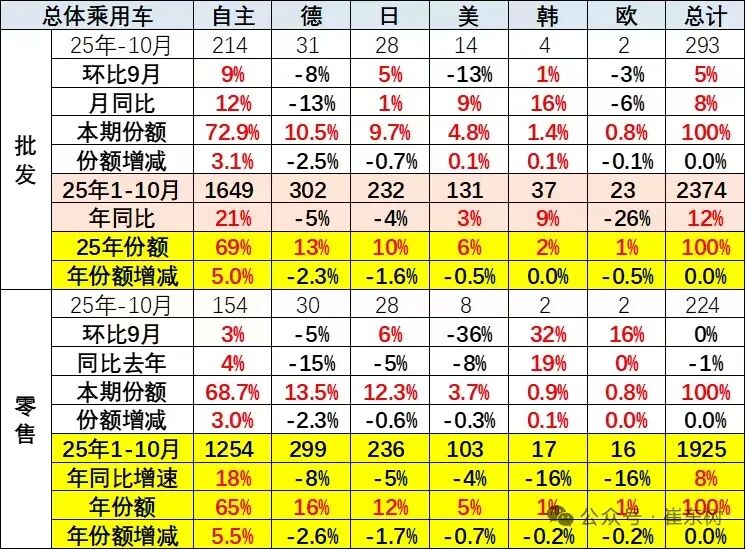
In the first 10 months of 2025, the cumulative wholesale sales volume of Chinese cars was 27.687 million units, a year – on – year increase of 12.40%; the sales volume of new energy vehicles was 12.943 million units, with a penetration rate of 46.75%. Among them, in October, the sales volume of new energy vehicles was 1.715 million units, with a penetration rate of 51.6%, exceeding half for the first time.
Shortly after the China Association of Automobile Manufacturers released the above data, more than one industry friend quietly asked us, “Didn’t the penetration rate exceed 50% long ago? Why are you still talking about it?”
Mr. He and I spent a lot of effort explaining around “fewer new energy commercial vehicles, more new energy passenger vehicles” and “fewer new energy export vehicles, more new energy domestic vehicles” to make them understand that actually, due to different statistical calibers, within the largest overall statistical scope, the new energy penetration rate has just reached around 47%; what we thought was “easily exceeding 50%” was actually the retail sales volume of domestic passenger vehicles.
Memory can be inaccurate, but I deeply remember a year: 1992, exactly 18 years from 2010, which is also the time it takes for a person to grow from birth to adulthood. In this year, Qian Xuesen wrote a letter to the State Council, suggesting the direct development of battery – powered vehicles, providing forward – looking strategic guidance for China’s selection of the development direction of new energy vehicle technology.
From then on, the State Planning Commission immediately included the research on key technologies of electric vehicles in the “Eighth Five – Year Plan”, focusing on the research of power battery technology. The Non – Ferrous Metals Research Institute where Wang Chuanfu worked participated in the battery research and development, which laid the foundation for BYD’s subsequent transformation.
People who are used to scolding “weak basic disciplines” in self – reflection may never have thought that when the critical voices were raging, it was the moment when tens of thousands of automotive industry practitioners were painstakingly accumulating.
During the transition period from 2015 to 2020, although there were numerous cases of new energy subsidy fraud and the bankruptcy of new – force car companies, in terms of technology, significant results were indeed achieved after opening up a new track. From 2020 to 2025, electrification and intelligent technologies have yielded various results. The iteration speed of Chinese automotive technology is like “transforming the heart of a car at the speed of mobile phone iteration”:
In the field of battery technology, in 2025, the energy density of power batteries for domestic electric vehicles increased by 40% compared with five years ago, and the cost decreased by 50%, achieving a breakthrough of “doubling performance and halving price”.
The average cruising range of pure – electric passenger vehicles is approaching 500 kilometers, and the domestic production rate of the whole vehicle has exceeded 95%.
In the field of intelligence, Chinese brands have become synonymous with intelligent assisted driving and are gradually breaking the shackles of “lacking core technology and software”.
The proportion of new passenger vehicles with combined assisted driving functions increased from 16.2% in 2020 to 62.1% in the first half of 2025. According to the statistics of Auto Commune, the penetration rate of the most advanced urban assisted piloting reached 12.4% in September.
The change in technological discourse power has become more and more obvious in the recent dynamics of enterprises: BYD has authorized its new energy technology to Toyota, achieving a historical breakthrough for Chinese car companies to export core technology to global giants; the Volkswagen Group has joined hands with XPeng and Horizon Robotics, and Stellantis has invested in Leapmotor. Global automotive giants have begun to recognize and accept Chinese technology.
There were almost no forward – developed gasoline – powered vehicle platforms in China in the past, but now XPeng’s platform is provided to Volkswagen for the development of new cars, and the electronic and electrical architectures of Leapmotor and SAIC are used by overseas partners; Huawei’s Hongmeng cockpit and Qiankun Intelligent Driving system have begun to be installed in joint – venture models, and power batteries such as those from CATL and Fudi are widely used in new energy vehicles at home and abroad; Geely’s power technology and other technologies are exported to Renault, a company with strong F1 technology, and also enter markets such as South Korea through Renault.
In fields upstream of platform architectures and power devices, China laid a solid foundation long ago.
Even in 2020, when we were criticizing the lack of forward – developed technology for gasoline – powered vehicles in the automotive industry, in terms of graphite for power battery anodes, Shenzhen BTR and Shanghai Shanshan were already among the top three global suppliers in terms of shipment volume. Among them, BTR even set a record of being the world’s number one for seven consecutive years by 2020.
As Hou Fushen, the vice – chairman and secretary – general of the Society of Automotive Engineers of China, said, the current achievements of the Chinese automotive industry have gone beyond a single technological or market breakthrough and evolved into a systematic revolution centered on low – carbonization, electrification, and intelligence.
03
Essence: Control of energy
There is a voice saying that the overseas market will continue to maintain the dominance of fuel – powered vehicles, “digging a pit” for the Chinese market, and finally China will fall into a self – indulgent “island – style” trap on the path of electrification and intelligent transformation.
This fallacy is not worth refuting because it completely fails to understand the essence of electric drive and intelligence.
Analyzed from the most fundamental level, the size of human capabilities depends on the magnitude, precision, and utilization rate of controllable energy.
In myths, gods can move mountains and seas, while humans can at most lift a tripod. The difference in weight is essentially a difference in energy control.
In science fiction, advanced civilizations can fly close to the speed of light, far exceeding the current level of humans. The difference in speed is a difference in kinetic energy, and the essence is still a difference in energy control.
Therefore, the level, efficiency, and precision of energy control determine the size of personal capabilities, the level of productivity, and the quality of life.
In the two industrial/energy revolutions, the first was the steam engine – chemical energy revolution, and the second was the electrical energy revolution. Each time, the energy that humans can control has been increased by an order of magnitude. If controllable nuclear fusion can break through the shackles, it will bring about the third energy revolution.
Computers and intelligence essentially optimize the control efficiency and precision of energy and information.
Compared with internal combustion engines, it is much easier for electrical energy to achieve a higher single – output energy. This is why new energy vehicles can easily achieve high – horsepower output. At the same time, the control of electrical energy only requires a Hall – effect sensor, which is in sharp contrast to the internal combustion engine, which has to rely on a precise and complex transmission system.
From military industry to high – speed railways and ships, electrification and even all – electric drive have long been realized, and intelligence has also been widely applied.
Therefore, we can infer that the automotive industry is the most important industry, and electrification and intelligence are the inevitable directions for the evolution of automobiles. The difficulties and obstacles in the process of evolution are tests full of tears and sweat and also opportunities given by “change”.
When self – owned brand cars in 2010 were confused about “why we can only mainly sell in the market below 100,000 yuan while the Highlander can even be sold at a premium”, the answer lies in technology. When it is difficult to catch up with overseas internal combustion engine technology
link