
Amid the ongoing nationwide shortage of automotive repair technicians, at least one technical school is seeing substantial increases in enrollment in its automotive programs, and even more eye-popping raises in its number of applicants.
The automotive repair industry must replace about 76,000 technicians per year due to retirements and new job demand, while only about 39,000 new service technicians graduate from career technical colleges and training programs yearly, according to the National Automobile Dealers Association. This leaves an annual shortage of about 37,000 trained technicians.
Meanwhile, State University of New York at Morrisville (SUNY Morrisville) has seen applications for its two-year automotive programs spike from 84 applications for the fall 2020 semester to 171 applications for fall 2025, and has watched applications for four-year automotive programs jump from 50 applicants to 78 during the same time span.
In an email to Autobody News, SUNY Morrisville Admissions Director Caleb McGuire touted those respective 104% and 56% increases as evidence of a stable repair industry, and of students’ thrill of working with evolving technologies endemic to the automotive industry.
Furthermore, SUNY Morrisville has experienced a roughly 50% increase in enrollment across all five of its automotive degree programs between 2020 and 2025, according to Matthew Polak, a SUNY Morrisville assistant professor and coordinator of the school’s automotive department and Mopar Career Automotive Program (MCAP).
Autobody News spoke with Polak for deeper insights on how SUNY Morrisville has successfully worked to drive enrollment in its automotive repair training programs, and how it has maintained robust industry partnerships to help achieve that goal.
How has SUNY Morrisville’s enrollment increased since the pandemic?
Pre-COVID, we were probably at 130 or so students across all of our degree programs. When COVID hit, for two years – 2020, 2021 – enrollment probably dipped right around just over 100 students. But it has now rebounded to the point where the numbers are higher than pre-COVID. We’re looking at 150 to 170 students that we’re currently serving across our five degree programs.
What Have You Done to Incentivize Enrollment?
We do live work here. Our junior and senior students operate the service desk. We’ve got a 50,000-square-foot facility, and each lab that would traditionally look like a shop in a dealership is specific to an ASE skill area. We have our own separate chassis lab, own separate engines lab, our own separate fuels lab. If a customer comes in and talks to our students that are working the front desk, and says, “Hey, I’ve got this clunk noise in the front of my vehicle,” those students will make them an appointment, generate a repair order using dealer management software, and delegate that to our chassis lab. The chassis students will diagnose and repair that vehicle. It’s a real-world working job.
That also allows the students to work on newer vehicles. Community members, students on campus, and faculty members all bring their cars to us to service repair.
It is very unique. I’ve never heard of it anywhere else.
What Else Has Driven Higher Enrollment?
I would just say, being a presence in the industry. Our alumni are worldwide. I had a student in my MCAP that was from Ireland, literally came here from Ireland.
I graduated from this program. I came from Michigan. I am very confident in our program, our faculty, staff and our facility that we’re one of the top educational institutions in the automotive industry in the country. If somebody comes here, I encourage them to check out every school you can, and find the right one for you. Usually if we get them on campus and they see what we have to offer, they end up coming.
Just like a couple of testaments to our programs: Our Ford ASSET Program just received a fancy Ford Mustang 5.0 because they were in the top 15 schools in the country for Ford ASSET as far as job placement.
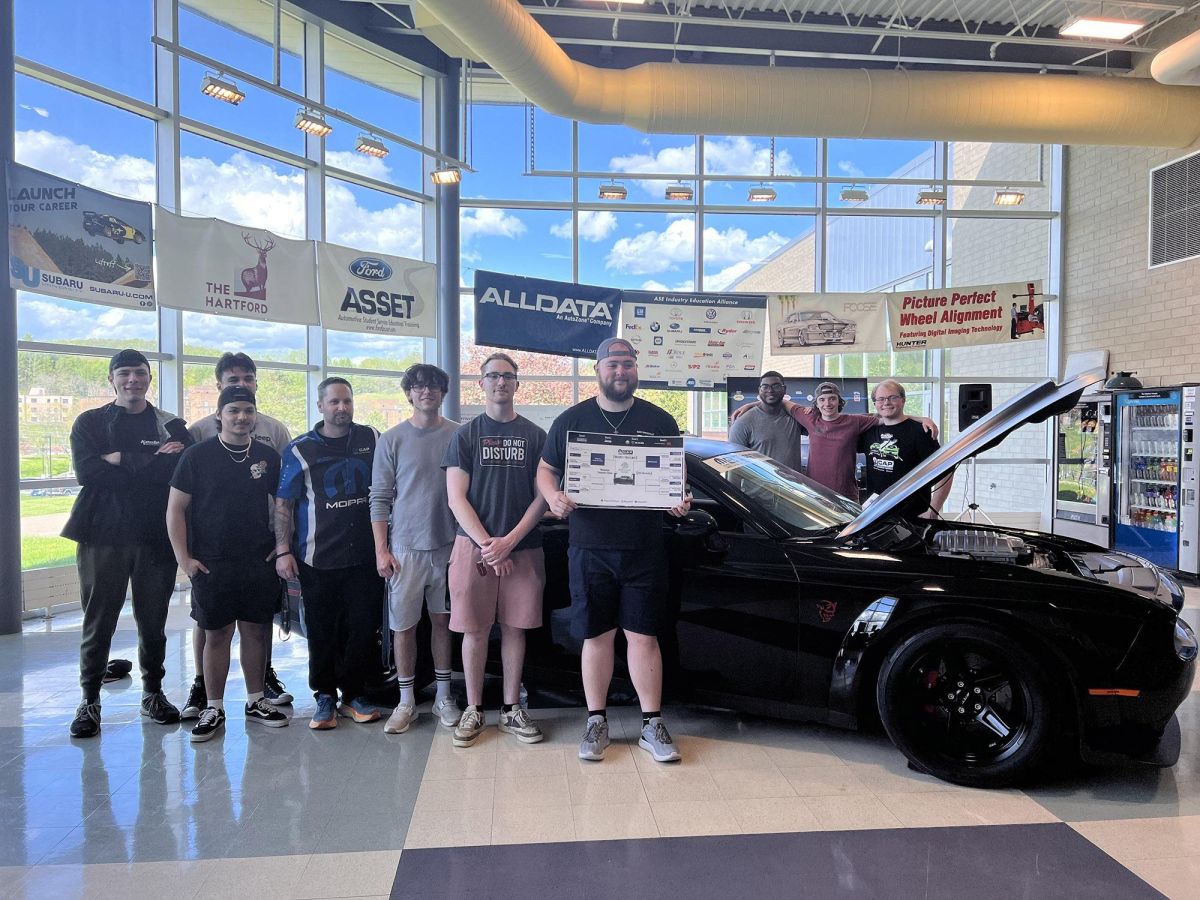 SUNY Morrisville MCAP students celebrate their win in the first-ever Mopar Career Automotive Program Bracket Challenge in 2024.
The MCAP program that I teach, two years ago, they had an NCAA-style bracket challenge. There are 100 Mopar colleges across the country, and they did a bracket and did a variety of different repair-related challenges. Phase One was a 200-question online electrical test. For the second one, we had to go to Rochester to our local training center, and they had to do four hands-on tasks.
We ended up going. They flew us to Detroit. We ended up winning the whole thing. And now we have a Dodge Demon in our showroom and we’re the No. 1 MCAP school in the country.
Things like that help incentivize enrollment. When they come and they see these two amazing cars and then you tell the story of how you got them, it kind of speaks for itself.
We wouldn’t be able to have the equipment, tooling and updated modern vehicles that we have without our manufacturer relationships. So, Stellantis, Ford, Subaru, I mean, it’s unbelievable what they’ve given us.
We’ve got 15 late model Chryslers, 15 late model Ford vehicles. That is a big challenge for educational programs, because, if your fleet that you’re trying to do demonstrations and train these students on are from even 2007, you look at a vehicle that’s 20 years old, that technology is just drastically different. With modern CAN bus systems and the software architecture that’s in these vehicles, you have to have these to prepare somebody to go into the industry.
Our fleet is top-notch. It is because of those partnerships. And some of the vehicles that we own are older.
Which Five Automotive Degree Programs Does Your College Offer?
We’ve got an associate degree in automotive technology as our foundation. This is basically diagnostics, repair and all the ASE skill areas. It’s an associate in applied science.
A lot of the degree programs are an occupational degree. You’re going to get all the same stuff that you have in an associate of science degree program. But in addition, you can continue on and get a bachelor’s, master’s or doctorate if you want.
That’s our footing, if you will, for our other two main automotive degree programs that are bachelor’s degrees. We also offer a bachelor’s in automotive technology, which during their junior and senior year basically focuses on advanced, hands-on engineering-type stuff, learning how to use a dyno, sun and boring equipment, advanced precision measuring and machining, those sort of things.
It’s technical, but they also get core management courses in automotive. What I mean by that is we do a service management, parts management and fleet management course, and we operate our facility like a dealership or a repair facility. Those students actively run our automotive facility like a dealership. They’re the service writers, service managers and delegate all the repair work to the individual labs.
Then, we also have a bachelor’s in business administration. That degree program, again, the first two years would be the automotive technology degree, and then they transfer into a lot of business administration courses.
They still take the automotive management courses, but then they’re going to take human resource management, marketing, operational management, other content that we offer in our business programs on campus. Those are our two bachelor’s degree programs.
We have an auto body associate’s degree as well, which focuses on the collision repair industry. And those students go to work as auto body technicians, insurance adjusters, those sort of things.
We incorporate our auto body program into our other automotive programs. What I mean by that is every single automotive student that we have — it doesn’t matter if they’re one of those 150 or 170 students — they are going to take our Auto Body 1 course. Every single student that we have goes through at least our introductory fundamental auto body course. They can also take those other auto body courses as electives.
We have students that can leave here with an associate’s degree in automotive technology, an associate’s in auto body technology with a bachelor of technology, inside of four to five years. We have it structured in a way where they can really get whatever they’re looking to get out of the automotive industry. They can tailor it exactly to them.
And then the other degree program that I would offer that is considered a separate degree is the Ford ASSET program.
If you have a student that knows that they want to be a Ford technician, that’s what it’s geared toward: manufacturing. We also offer manufacturer training from Subaru, and we have our MCAP program which I coordinate.
Any student in any program can take that manufacturer training. In fact, I have an auto body student that is currently also taking the MCAP. The cool part about our programs, you can really tailor them toward exactly what you want to do.
What Other Partnerships Do You Have With Repair Companies, Dealerships and OEMs?
As far as our OEM training, we teach just like they would teach at the dealership. That would be Ford, Subaru and Mopar Stellantis: Chrysler, Jeep, Dodge, Ram, Fiat. We do I-CAR curriculum in our body program, I-CAR Academy.
We do Chief training here on campus as far as frame measurement. We do I-CAR welding certification. We do Snap-on’s measuring certification for their digital volt-ohm meters (DVOMs) and precision measuring. When students go through our electrical courses, they’re certified to use the DVOM. We have their actual precision measuring kit, and they can become Snap-on-certified in precision measuring.
We have partnerships with area industries. We’ve got partnerships with Hartford Insurance, and all the different dealerships. We’ve got reps that work for Ford, Chrysler. We’re pretty tied in with all of them.
What’s the Tie-In with Hartford Insurance?
They’ll hire students right out of our program as insurance adjusters.
And the cool thing about that most of those students are relocated. They’re like, “I’ve always wanted to go to Colorado or California.” It’s a great opportunity for a student to get an awesome-paying job, and go exactly where they want and be tied in right out of school.
A large percentage of SUNY Morrisville graduates still work for Hartford Insurance in the location that they chose out of school.
What’s Your Job Placement Rate?
It’s pretty much 100%. Any of these students that graduate from our program can get a job anywhere in the country.
Shops around the country are starving for individuals. I just sat in on a Chrysler conference, and they’re currently looking for, across the nation, 15,000 technicians. And they predict by 2030 that they’re going to need 45,000 to 55,000 technicians across the country.
To fill the void that’s coming up, it’s going to be difficult. There is such a need. Most of these students have jobs their first semester. Occasionally, we run into a challenge where a student will start with us and get a year into the program, and over the summer, they’re working at a dealership and that dealership makes them an offer they can’t refuse. Sometimes, we lose a student because they’re like, “Hey, they’re telling me they’re going to pay me $40 an hour.”
It’s hard. That’s a challenge that we do face.
Will AI Fill Tech Positions for OEMs?
I think that’s why we’re seeing a growth in enrollment. We’re finally seeing these areas. Those are the things that are not going to be filled by technology. It will to a certain extent, but it’s basically going to make your job more efficient. You’re still going to need these people to fill positions.
How Have Your Courses Evolved in Response to New Technologies?
All of our faculty are always undergoing professional development on the latest and greatest. Again, those manufacturer programs definitely help.
Having access to the latest and greatest service information, scan tools, tooling, equipment. For example, in Chrysler, they came out with a new 3.0 L Hurricane. So, we get one of those and the next thing you know, a pallet shows up and it’s all the different tooling and equipment specific to carrying that engine down and rebuilding it.
The other thing that we just acquired was a $250,000 New York state EV grant. Two of our faculty members — one went out to Moab, UT, and spent a few weeks out there training on EVs. And the other one went somewhere in Massachusetts to get trained.
We just installed Level 2 chargers in our building. We got a [all-electric] Subaru Solterra, and we’ve got a Tesla Model 3 that is en route. They’re in the process of developing an EV curriculum that will be open to students and industry professionals as well.
If you have technicians that are working at an independent shop and you want to train your technicians on EV, they can send them to us, and we can bring them.
Which Courses Are Students Showing the Most Interest In?
It’s a variety. It really depends on their interest.
I would say our biggest driver is a lot of these students come to us and they want to own their own shop, or they’re into performance like all of us were when we were young motor heads. A lot of students will come and they’ll enroll in one of our associate degree programs thinking, “Ah, I want to get a two-year degree. I want to go out, work, make some money,” and then what ends up happening is they see the junior and senior students that are operating the service desk, running the show, and that we have our own active parts department.
A large percentage of them then say, “Alright, I’m going to transition into the four-year BTE [Bridge to Employment] or BTEA [Back to Education Allowance] program.”
In our BTE program, we teach a couple of courses. Advanced diagnostics is one that I teach, in which we go into a lot of the advanced performance stuff that we’re seeing on a lot of these vehicles, turbochargers, forced induction. We talk a lot about tuning in that class, utilizing HP Tuners, just because it’s similar to what a software engineer would see working for GM. It might serve a different purpose, the way you’re programming a vehicle, but it allows you to see the things that you have to deal with to get a modern vehicle to run and run properly. They get big into that using the dyno.
Our BTE students also take an advanced chassis course. We offer Chassis One, Chassis Two, which is all your standard ASE stuff — brakes, suspension, alignments, all that good stuff.
Advanced chassis gets into setting up performance vehicles.
Right now, another less formal relationship that we have is one of our former students is the New England rep for BMW USA. He just dropped off a BMW — I don’t know exactly the model — a $60,000 car, and we’re putting a performance exhaust on it, a big brake kit and putting an OEM suspension package in the car.
We’ve got another Jeep right next to it that Maguire [of Syracuse, NY] gave to us, and they’re putting a lift kit and some big tires on it. They see those goodies and they’re like, “I want to do that.”
Going back to the cars, the cool Mustang, the Dodge Demon we have, in addition to those, our body of students has built a 1988 Mustang drag car that we’ve taken to the drag strip for years. It was built 30 years ago by our program. Our school colors used to be green and yellow, so it’s painted green and yellow. We’re literally in the process of revamping that with our new colors of black, green and white. So these students are coming up with all these concepts and they’re in the process of painting that vehicle and bringing that to our current image.
How Long Have Students Spent Three hours in the Lab and One in Class Every Day?
As long as I can remember. I graduated from the program in 2007, and it’s been that way since then.
So, for every hour you’re in a lecture or a classroom application, you’re going to spend three hours out in the lab. And in some cases, like our body program, that number is even higher. For one course in our auto body degree program, for every hour of lecture, it’s seven hours in a lab.
And then for our capstone class in that program, their lab is literally 12 hours. So, that’s a lot of hands-on time. Even with 150 to 170 students, we currently have 11 or 12 faculty members and three adjunct instructors as well. The max you’re going to have is probably eight to 10 students in a lab. And in most cases, it’s probably more like six.
How Do You Use Virtual Reality?
Two ways. Ford, as a manufacturer, part of their training that they even sent to the dealerships is a VR unit that teaches some of the introductory chassis stuff and operating an on-car brake lathe. You can literally do it in VR, set it up. And it’s wild. You watch a student or somebody do it, and they’ve got this headset on and you can see them. They’re putting the machine and turning stuff. So, it’s pretty cool.
The second way that we utilize VR is for recruitment. That has some different basic automotive skill stuff. If they’re going to a BOCES [New York state Board of Cooperative Educational Services], for example, and they’re setting up a booth, they can say to students, “Hey, put this on, check this out,” and use it as a recruitment tool.
Which New VR Applications in the Repair Space Are Feasible?
I think anything that can utilize fine motor skills could be very useful. In our auto body courses, for example, we spend five weeks doing the I-CAR welding certification, cosmetic welding. Right now you have to order the materials, the metal. But to get I-CAR welding certification, they’ll send you pieces of metal, you have to perform all your lab welds, plug welds, and then you’ve got to send it back to them, and then they check them over to certify.
I could see a situation where maybe I-CAR says, “Alright, we’re going to switch to VR,” and if it’s accurate enough where we can tell if those welds have the proper penetration and application, I could see stuff like that in the future, at least in the training application of it.
Was There Anything Else You Wanted to Add?
If you go to our website, you can click on any of our automotive programs, and it’ll give you a rough idea of our facilities.
link