
Automotive Fuel Level Sensor Market Dynamics
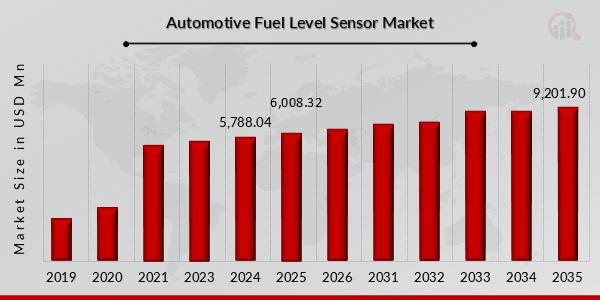
As per the latest analysis by Market Research Future, Automotive Fuel Level Sensor Market Size was valued at USD 5,788.04 million in 2024. The Automotive Fuel Level Sensor market industry is projected to grow from USD 6,008.32 million in 2025 to USD 9,201.90 million by 2035, exhibiting a compound annual growth rate (CAGR) of 4.35% during the forecast period (2024 – 2035).
With the global automotive industry focused on precision, safety, and sustainability, the demand for advanced fuel level sensors is on the rise. These critical components provide real-time data on fuel levels, helping vehicle owners manage fuel consumption and enabling manufacturers to meet increasingly stringent regulatory requirements. In response to this growing demand, leading automotive technology companies are expanding their fuel level sensor solutions with enhanced accuracy, durability, and integration capabilities.
Request Sample Report; https://www.marketresearchfuture.com/sample_request/27801
Fuel level sensors are an essential part of the fuel management system in passenger cars, commercial vehicles, and off-highway applications. They play a key role in providing accurate information to drivers and vehicle control units, ensuring optimal engine performance, preventing fuel starvation, and improving fuel economy.
Advancing Sensor Technology for Greater Accuracy
Modern fuel level sensors are far more advanced than traditional float-based designs. Capacitive, resistive, and ultrasonic technologies are now commonly used to improve accuracy, reduce mechanical wear, and provide consistent readings even in challenging conditions.
Capacitive sensors, for instance, measure fuel level based on the change in capacitance as fuel enters or leaves the tank. Ultrasonic sensors use sound waves to measure fuel levels without coming into direct contact with the fuel, eliminating contamination issues. These innovations allow for precise monitoring, even when vehicles operate on steep gradients or rough terrain.
Automotive Fuel Level Sensor Market Players & Competitive Insights
Major market players are spending a lot of money on R&D to increase their product lines, which will help the Automotive Fuel Level Sensor Market grow even more. Market participants are also taking a range of strategic initiatives to grow their worldwide footprint, including new product launches, contractual agreements, mergers and acquisitions, increased investments, and collaboration with other organizations.
Key Companies in the Automotive Fuel Level Sensor Market include;
o GILL SENSORS & CONTROLS LIMITED
o TE CONNECTIVITY CORPORATION
o ROBERT BOSCH GMBH
o TECHNOTON
o ALLEGRO MICROSYSTEMS, INC.
o CONTINENTAL AG
o REVENTEC LTD
o SENSATA TECHNOLOGIES, INC.
o RB AUTOMATION
o BOURNS, INC.
o DENSO CORPORATION
Supporting Fuel Efficiency and Emissions Goals
Accurate fuel level sensing plays a significant role in helping automakers meet global emission and fuel efficiency standards. Advanced sensors can communicate directly with the vehicle’s engine control unit (ECU), allowing optimized fuel injection strategies and reducing wastage.
In addition, many fuel level sensors now integrate temperature compensation features to ensure reliable readings in extreme climates. By providing real-time data, these sensors help prevent unnecessary fuel consumption and support environmental sustainability initiatives.
Buy Complete Report; https://www.marketresearchfuture.com/checkout?currency=one_user-USD&report_id=27801
Integration with Modern Vehicle Electronics
As vehicles become increasingly connected and automated, fuel level sensors are evolving to integrate seamlessly with onboard diagnostic systems and telematics platforms. This allows fleet operators and vehicle owners to remotely monitor fuel consumption and detect anomalies such as leaks or theft.
Many advanced sensors now feature digital communication protocols such as CAN (Controller Area Network), enabling easy integration with modern automotive electronics. This connectivity is essential for next-generation vehicles, including hybrids and plug-in hybrid electric vehicles (PHEVs), where fuel management is a complex process.
Meeting Global Production Demands
To cater to the rising demand, manufacturers are expanding production facilities and enhancing supply chain capabilities. Automotive technology firms are building new manufacturing lines in key regions such as North America, Europe, and Asia-Pacific to ensure rapid delivery to vehicle OEMs.
Strategic partnerships with tier-1 suppliers and aftermarket distributors are also being prioritized to expand product availability. Modular designs that can be adapted for multiple vehicle models are helping manufacturers reduce production costs while maintaining high-quality standards.
Addressing Hybrid and Alternative Fuel Applications
The shift toward electrified powertrains has created new opportunities for fuel level sensor innovation. Hybrid vehicles, which alternate between electric and internal combustion power, require highly accurate sensors to manage complex fuel usage patterns.
Fuel level sensors are also being designed to handle biofuels, ethanol blends, and other alternative fuels, ensuring compatibility with the evolving energy landscape. Some manufacturers are even exploring hydrogen-compatible sensors to support the adoption of fuel cell electric vehicles (FCEVs).
Importance in the Aftermarket Segment
Beyond original equipment manufacturing, the aftermarket for automotive fuel level sensors is expanding steadily. Aging vehicles often require sensor replacements to maintain fuel system reliability. Aftermarket suppliers are introducing durable, plug-and-play solutions compatible with a wide variety of vehicle makes and models.
These replacements help vehicle owners maintain fuel efficiency, prevent breakdowns, and avoid costly repairs. With large aging fleets in regions like Latin America, Africa, and parts of Asia, the aftermarket remains a crucial growth area.
Explore More Insights on Automotive Fuel Level Sensor Market; https://www.marketresearchfuture.com/reports/automotive-fuel-level-sensor-market-27801
Skilled Workforce and Quality Assurance
The production of advanced fuel level sensors requires a highly skilled workforce capable of managing complex design and testing processes. Manufacturers are investing in training programs to ensure engineers and technicians remain up to date with the latest sensing technologies, safety standards, and quality assurance protocols.
Extensive testing in diverse environmental conditions is conducted to guarantee durability and accuracy. This includes vibration, temperature, and fuel compatibility testing to ensure sensors perform reliably throughout a vehicle’s lifespan.
Rising Demand for Vehicle Data and Analytics
As automotive digitalization accelerates, fuel level sensors are expected to play an even larger role in data collection and analytics. Fleet managers can use sensor data to optimize route planning, reduce fuel costs, and monitor driver behavior. For consumers, connected dashboards can provide predictive fuel alerts and real-time updates, enhancing convenience and safety.
Future Outlook: Smarter and More Sustainable Sensors
Looking ahead, automotive fuel level sensors will continue to evolve with the introduction of smarter, more sustainable designs. Sensors capable of self-diagnostics and predictive maintenance will become standard, reducing vehicle downtime and improving reliability.
In addition, the use of recyclable materials and eco-friendly manufacturing processes will align with the automotive industry’s broader sustainability goals. Fuel level sensors designed for emerging fuels, including hydrogen and synthetic fuels, will also gain traction as the world transitions toward cleaner energy sources.
Explore More;
Hydraulic Gear Pump Market
https://www.marketresearchfuture.com/reports/hydraulic-gear-pump-market-6768
Automotive Shielding Market https://www.marketresearchfuture.com/reports/automotive-shielding-market-6926
Automotive Throttle Position Sensor Market https://www.marketresearchfuture.com/reports/automotive-throttle-position-sensor-market-7596
Automotive Chip Market https://www.marketresearchfuture.com/reports/automotive-chip-market-7676
Led Fog Lamp Market https://www.marketresearchfuture.com/reports/led-fog-lamp-market-8219
Automotive Fleet Leasing Market https://www.marketresearchfuture.com/reports/automotive-fleet-leasing-market-4328
Remote Vehicle Shutdown Market https://www.marketresearchfuture.com/reports/remote-vehicle-shutdown-market-4664
Automotive Adaptive Cruise Control Market https://www.marketresearchfuture.com/reports/automotive-adaptive-cruise-control-market-4858
Automotive Thermal Management System Market https://www.marketresearchfuture.com/reports/automotive-thermal-management-system-market-6063
Automotive Simulation Market https://www.marketresearchfuture.com/reports/automotive-simulation-market-7280
Electric Vehicle Thermal Management System Market https://www.marketresearchfuture.com/reports/electric-vehicle-thermal-management-system-market-8151
Solar Powered Vehicle Market https://www.marketresearchfuture.com/reports/solar-powered-vehicle-market-7946
Market Research Future
99 Hudson Street, New York 10013, USA
Sales: +1 628 258 0071(US) , +44 2035 002 764(UK)
Email: [email protected]
Website: www.marketresearchfuture.com
LinkedIn: https://www.linkedin.com/company/market-research-future
Twitter: https://twitter.com/MRFRresearch
About Market Research Future:
Market Research Future® (Part of WantStats Research and Media Pvt. Ltd.) has specialized research analysts in the areas of Aerospace & Defense, Automotive, C&M, Energy & Power, F&B, Healthcare & Pharmaceutical, ICT, Industrial Equipment, Packaging Construction & Mining and Semiconductor. Market Research Future (MRFR) is a global market research company that takes pride in its services, offering a complete and accurate analysis with regard to diverse markets and consumers worldwide. MRFR’s approach combines the proprietary information with various data sources to give an extensive understanding to the client about the latest key developments, expected events and about what action to take based on these aspects.
This release was published on openPR.
link